
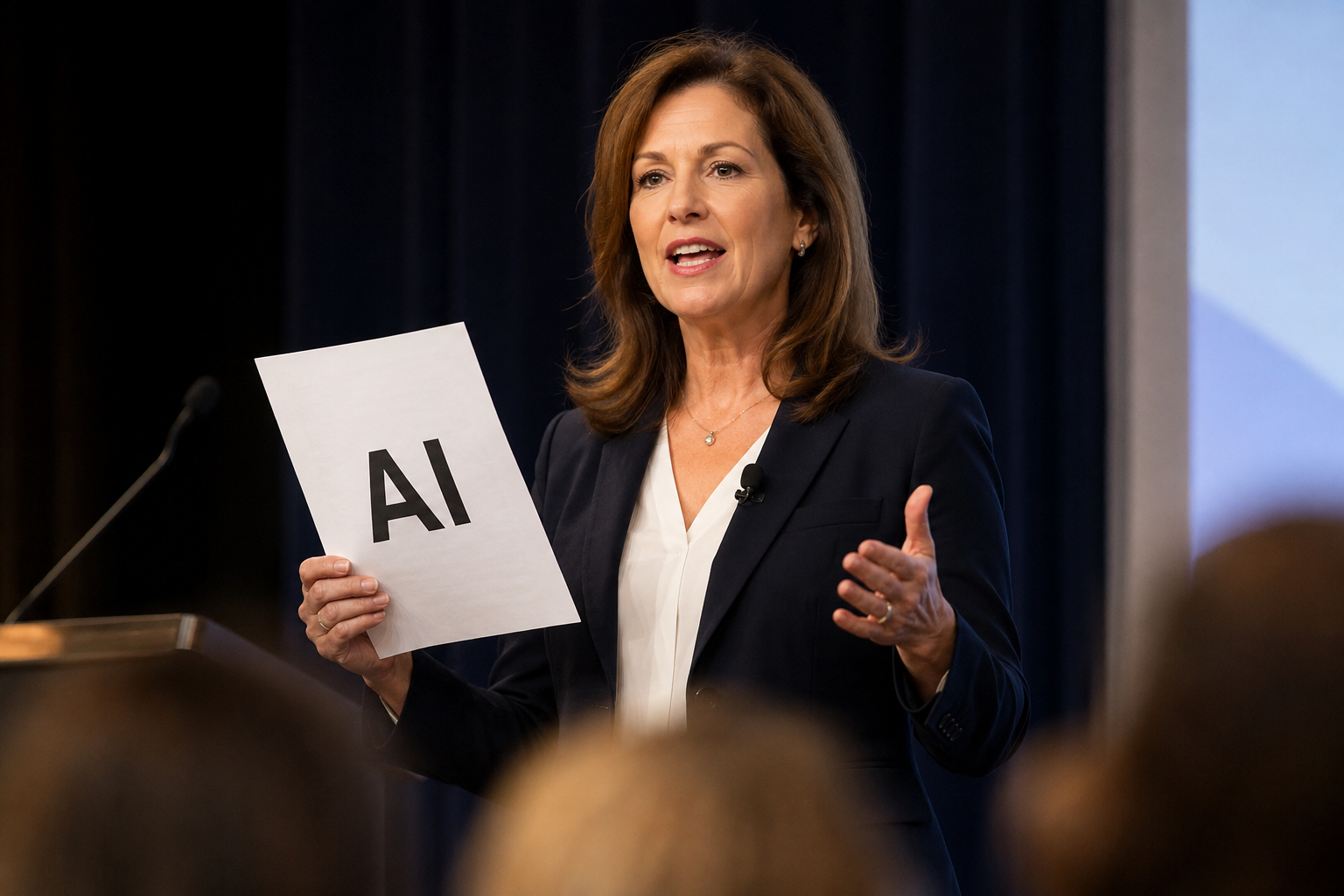
Why would you write a speech with AI? Yes, it saves time. It’s convenient. And it’s a remedy for writer’s block. Or is it? The audience can recognize content that sounds computer generated and once they sense that it’s not you, your credibility can be compromised.
Content creator, Adrian Miller, Founder of Words Work Copywriting, works with entrepreneurs and companies to write their content. She’s noticed a trend recently. People are using AI to write their speech and then they call her to clean it up and make it sound like them. Not every speech writer can capture a speaker’s voice and AI certainly doesn’t do that well. AI generated speeches sound formal, generic. and lack personality.
But if you insist on writing a speech with AI here are some tips for making the speech sound like you.
1. Don’t write a speech with AI. Try talking out your ideas into a recording device. Then edit the transcript.
2. Give AI your topic and content for the speech and ask it to generate a list of bullet points.
3. Choose the appropriate number and the best bullet points that work with your timing or word count.
4. Ask AI to organize your chosen points into a logical sequence.
5. Rewrite the points in your own language. Include the expressions you normally use. Ex. “You guys”
6. Add your own personal stories, case studies, and experiences. This is a major distinction between AI-generated and human speech writing. Content created by AI cannot tell your story or speak in your voice. Speak your stories out loud so that they sound like you. Practice until you sound conversational.
7. Provide specific personal details. “A year ago, when I first joined the company….” AI cannot drill down into your personal experience for every point or story. Being specific is an indicator of a human speech. As the saying goes, the devil is in the details.
8. Use short sentences. AI tends to be formal. You want a speech that is written for the ear, not for the eye. Shorter sentences make you sound conversational.
9. Insert strategic pauses. AI may string a number of sentences together. A human approach is to stop and pause. This allows the audience to process the message and for your point to land.
10. Don’t aim for perfection. That’s what makes it sound artificial. It’s okay to use contractions or occasional slang if that’s how you speak. When I was first starting out. I auditioned as a subcontractor for a training company. We all had to audition by delivering 5 minutes of the training material. Being confident in my platform skills I approached the front of the room. I delivered point 1, point 2 and then………..Dead silence. I forgot point 3. After a long pause, I remembered the point and sat down. Afterwards, one woman in the audience approached me and said, “I’m glad that happened. Otherwise, you would have been too perfect.” That was an eye-opener for me. Reject AI perfection and aim for human imperfection. The audience wants to know you’re real.
Finally, once you have your written speech, practice good delivery skills by varying your intonation and pace. Familiarize, don’t memorize. If you must write the speech with AI here’s how to leverage AI without sacrificing your voice:
Follow these steps:
Create the speech with AI.
Personalize it.
Internalize it.
Connect with the Audience.
And that’s how to write a speech with AI and make it sound like you.
Connect with me on LinkedIn
Subscribe to my youtube channel
To work with me visit diresta.com
 How is
 Today is Take a Second Look Day. That means it's a day to repurpose, reuse, or redistribute your content. It can apply to anything in your life. Since many public speakers freeze when they have to prepare a speech or presentation, I thought it would be valuable to apply this "Take a Second Look" concept to preparing a presentation.
Panel Presentations
Let's say you're asked to speak on a panel or to give a stand-up presentation on your topic of expertise. You're staring at a blank piece of paper and wondering how to begin. Who says you have to start from scratch? Use what you already have done. Take a look at past presentations, documents, proposals, blogs, and articles you're written. What is the main topic or theme? How can you repackage it?
Today is Take a Second Look Day. That means it's a day to repurpose, reuse, or redistribute your content. It can apply to anything in your life. Since many public speakers freeze when they have to prepare a speech or presentation, I thought it would be valuable to apply this "Take a Second Look" concept to preparing a presentation.
Panel Presentations
Let's say you're asked to speak on a panel or to give a stand-up presentation on your topic of expertise. You're staring at a blank piece of paper and wondering how to begin. Who says you have to start from scratch? Use what you already have done. Take a look at past presentations, documents, proposals, blogs, and articles you're written. What is the main topic or theme? How can you repackage it?