
 What if there was a way for you to rev up your audience every time? What if you could anchor them emotionally to your message during every presentation? Well, you can. The top public speakers know the secret to successful speaking and creating a wow factor for the audience. Motivational speakers use music.
Listen to your favorite song on the radio and you'll experience a flood of memories. That song is ingrained in your brain. Music is a powerful anchor to your emotions. You hear the song and you're instantly transported to that time and place where you first heard it.
What if there was a way for you to rev up your audience every time? What if you could anchor them emotionally to your message during every presentation? Well, you can. The top public speakers know the secret to successful speaking and creating a wow factor for the audience. Motivational speakers use music.
Listen to your favorite song on the radio and you'll experience a flood of memories. That song is ingrained in your brain. Music is a powerful anchor to your emotions. You hear the song and you're instantly transported to that time and place where you first heard it.
Did you ever wonder why every national convention plays music before the presentations, during the breaks, and after the presentations? Music creates an emotional link.
Dr. Concetta Tomaino, director of the institute for Music and Neurologic Function states, "Once the emotional link to music is established, our neurological reactions are profound. Our brain creates hard-wired responses to certain situations that are repeated when listening to the music. Music can actually change our mood. In fact, it can increase performance.
Certain songs can trigger the release of dopamine and seratonin in the brain which are "feel good" hormones. Music that is uplifiting should have the same rhythm as our heartbeats (60-80 beats per minute). Mozart and many classical pieces have this rhythm. Rhythm above 80 beats per minute can rev up the crowd or cause anxiety. That's why many conventions play rock music. It has a fast beat to energize the audience.
Music will enhance your presentations and seminars. Use slower music for writing or group exercises. Pump up the volume and the beat to energize and motivate the audience. When you play music during a paid speaking engagement, be aware that you'll need to pay a licensing fee. Or, you can buy royalty free music.
Today's audiences expect an entertaining experience. Experiment with music and watch the magic happen.



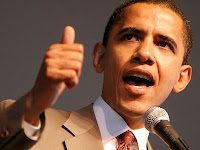 There was a popular song years ago that went " Who let the dogs out?" And that's a question that's apropos this week in the media. The answer is President Obama let the dogs out in his recent speech in Milwaukee. Alluding to his opponents he said, 'They're talking about me like a dog." What does this tell us? Language reflects thought. While some studies state that words are only 7 per cent of the message, words are powerful. They give us insight into what the speaker believes and feels. In this case, Obama is saying he feels like a victim. The key is the wording "They're talking about ME". It's something that is happening to him. It's not the language of leadership. There is a difference between being genuine and appearing weak.
Former Mayor Giuliani showed genuine sadness during the bombing of the World Trade Center but he never spoke like a victim.
There was a popular song years ago that went " Who let the dogs out?" And that's a question that's apropos this week in the media. The answer is President Obama let the dogs out in his recent speech in Milwaukee. Alluding to his opponents he said, 'They're talking about me like a dog." What does this tell us? Language reflects thought. While some studies state that words are only 7 per cent of the message, words are powerful. They give us insight into what the speaker believes and feels. In this case, Obama is saying he feels like a victim. The key is the wording "They're talking about ME". It's something that is happening to him. It's not the language of leadership. There is a difference between being genuine and appearing weak.
Former Mayor Giuliani showed genuine sadness during the bombing of the World Trade Center but he never spoke like a victim. For years I've talked about the power of three's. I advise my clients to present 3 agenda items, 3 main points, and 3 benefits. People remember things in three's.

 I just returned from a networking event. The venue was crowded and noisy. The host tried to get our attention by speaking over the crowd. We had difficulty hearing him and he was obviously straining his voice. Straining your voice can cause laryngitis, vocal nodules and inflammation. A vocal pathology affects your image but can also cause you to cancel meetings and lose business. Too many people misuse their voices.
To protect your voice, here are some tips for good vocal hygiene:
I just returned from a networking event. The venue was crowded and noisy. The host tried to get our attention by speaking over the crowd. We had difficulty hearing him and he was obviously straining his voice. Straining your voice can cause laryngitis, vocal nodules and inflammation. A vocal pathology affects your image but can also cause you to cancel meetings and lose business. Too many people misuse their voices.
To protect your voice, here are some tips for good vocal hygiene: