Public Speaking

Video Marketing-The New Interview Presentation

How do you make your job interview stand out in a crowded interview? In a previous post I blogged about a woman who was getting ready to pitch her boss for a promotion.  To make her and her presentation memorable we decided to create a short video. Why? Because I see a change in the market. Youtube.com is the number two search engine after google.  Video creates that personal touch and ups the trust factor in presentation marketing.  Well, now it seems that interviewers are catching on.  Is the resume becoming passe? Probably not. But a video presentation can sell you better than any piece of paper. An expert can write a professional resume but nobody can speak for you. Speakmarketing is one of the most powerful ways to promote a business and create visibility inside the workplace. So it makes sense that video presentation would be the next wave in job interviews.  Now more than ever before, everybody must have good presentation skills. Speaking is the new competitive weapon.

Read this WSJ article about the impact of digital media.

http://online.wsj.com/article/SB10001424052970203750404577173031991814896.html?mod=googlenews_wsj

Speaking to a Grieving Audience

The other evening I was preparing for my next Confidence Class for eighth grade girls in my community when an email came across my desk. A mother warned me that the principal of the school died yesterday afternoon suddenly and unexpectedly of a heart attack.  She alerted me that the girls were shocked and broken up by the news and she wasn’t sure how responsive they would be in the class. I thanked her for letting me know and planned my strategy. I recalled a professional speaker who spoke before an audience that was not responding. No matter what he did he couldn’t get a reaction. They just sat there with blank faces. Finally, he played his last card and said with exasperation, “What’s going on? Did somebody die?

Stop Setting Speaking Goals That Fail

You want to be a great public speaker and communicator. So you set your goals. And it doesn't happen. Why? You may be sabotaging your speaking success without even knowing it! The top public speakers and presenters know the secret to communication success is setting the right goals. Whether you're speaking to the media, presenting to the board, or leaving a voicemail, good presentation skills start with a goal.

In this video you'll learn the two types of goals and how to choose the goal that will let you succeed.

[youtube]http://youtu.be/CY_z889b-SI[/youtube]

Leave a comment.

Political Presentations: The Double Standard Continues

GOP DebatersIn June, I blogged about Michele Bachmann and the double standard for women politicians. It seems that the media continues to display sexism toward women candidates. Whether it's Hillary Clinton, Sarah Palin, or Michele Bachmann there seems to be an element of sexism even as we approach 2012. First we had to hear the commentary each time Hillary had a new hairstyle. While this may be appropriate for a First Lady, when a woman is running for political office she ought to be taken more seriously. How often do we critique a male candidate's hair? (Donald Trump doesn't count).

During the Republican debates, Michele Bachmann was accused of not knowing her facts - even when she did. In one debate, she bested Newt Gingrich regarding his involvement in Fannie Mae, yet the media did not make much of her win.

The most recent sexist remark was by John McLaughlin of the McLaughlin Group when he said we have a "Gal Candidate".  A GAL?  A friend asked me if I would find it offensive if his 87 year old father referred to a woman as a gal. I replied, "No. He's a product of his times. But a journalist and moderator knows better. He's on national TV and is subject to professional standards.  He didn't refer to 'guy candidates'".

Language is a mirror into how one thinks. It's difficult to be taken seriously as a woman candidate when you're called a "gal". It's amazing that this kind of double standard is going on in the U.S., when other countries have elected a woman president or prime minister.

As a public speaker and debater, Michele Bachmann has handled  herself well by sticking to the facts and not showing a lot of emotion.  Will gender always be a factor?  Is it possible to evaluate the candidates on their merits, without considering gender?  Or will it always color our perceptions?

Leave a comment.

Public Speaking: When Science Meets Art

There are no boring topics-only boring speakers. I say this in all my speeches and seminars. The audience may look at me with skepticism but they eventually realize the truth. I tell them the story about Elliot who was in one of my Knockout Presentations workshops. I asked him to talk about a passionate topic. He chose his job of inventory control. After failing to convince him to choose another topic, I listened to Elliot speak about his job. Well, I was totally surprised. Elliot really was passionate about inventory control! The reason many presentations are boring is because the speakers lack passion. The give me the excuse that their topic is technical. Well, I'm here to say that public speaking is both a science and an art and when the two intersect it's magical. Here is a video to show how an otherwise dry presentation can be captivating and engaging when you combine it with art and creativity. Do you think this speaker engaged the audience? Do you know the art and science of speaking? What's stopping from giving a knockout presentation?

Leave a comment.

Confident Public Speaking Starts Too Late

After 20 years consulting in corporate America I've come to this conclusion. We wait too long to build confident leaders.  Important leadership skills such as public speaking and confident communication must begin much earlier. That's why I started a Confidence Class for middle school girls in my community. In 2006 a mother called me. I don't know how she got my name. She explained that her daughter got nervous standing up and speaking in her 7th grade class. She wanted me to teach her to be confident. Although I coach business leaders to project executive presence, she was so persistent that I caved in. I told her if she could get 10 girls together I would teach a class on the weekend. To my surprise, she rounded up 10 lovely middle school girls from the same class and we had our first meeting in her house.

I discovered that I really enjoyed working with them and it brought back memories of my speech pathology days in the New York City schools. After learning skills of confident public speaking, her daughter gave a reading in her church before 100 people. Another girl, gave the acceptance speech for her grandfather at his legal society dinner of 800 attorneys. She received a standing ovation. It seemed the success of the classroom had spilled over into their every day lives.

And now here I am again, doing my third confident public speaking class for middle school girls. Three daughters in one family have now attended my class to become confident public speakers. The second sister went on to debate on a National level. Her mother told me that the Confidence class in public speaking served as the foundation for her to go on to join the debate team.

In each one hour session, the girls learn the same skills I teach adults in companies, learn to give each other balanced feedback, and watch themselves on videotape. What would happen if young students learned these skills when they were young? There would be fewer bad presentations. They would be better leaders. And maybe more women could chip away at the glass ceiling.

Leave a comment.

Speak To Be Heard

Do people talk over you so that your voice isn't heard? Do you shut down because nobody listens when you speak? As a public speaker, do you have to shout to get the group to quiet down and listen to you? When you're speaking one-to-one, do you experience constant interrupting? In this video, you'll learn three reasons why you're not being heard and what you can do to be a more effective speaker and communicator.

View on YouTube


What Every Motivational Speaker Knows That You Don't

What if there was a way for you to rev up your audience every time? What if you could anchor them emotionally to your message during every presentation? Well, you can. The  top public  speakers know the secret to successful speaking and creating a wow factor for the audience.  Motivational speakers use music. Listen to your favorite song on the radio and you'll experience a flood of memories. That song is ingrained in your brain. Music is a powerful anchor to your emotions. You hear the song and you're instantly transported to that time and place where you first heard it.

Did you ever wonder why every national convention plays music before the presentations, during the breaks, and after the presentations? Music creates an emotional link.

Dr. Concetta Tomaino, director of the institute for Music and Neurologic Function states, "Once the emotional link to music is established, our neurological reactions are profound. Our brain creates hard-wired responses to certain situations that are repeated when listening to the music. Music can actually change our mood. In fact, it can increase performance.

Certain songs can trigger the release of dopamine and seratonin in the brain which are "feel good" hormones. Music that is uplifiting  should have the same rhythm as our heartbeats (60-80 beats per minute). Mozart and many classical pieces have this rhythm.  Rhythm above 80 beats per minute can rev up the crowd or cause anxiety. That's why many conventions play rock music. It has a fast beat to energize the audience.

Music will enhance your presentations and seminars. Use slower music for writing or group exercises. Pump up the volume and the beat to energize and motivate the audience.  When you play music during a paid speaking engagement, be aware that you'll need to pay a licensing fee. Or, you can buy royalty free music.

Today's audiences expect an entertaining experience. Experiment with music and watch the magic happen.

The Fine Art of Public Speaking

Is speaking an art or a science? I say it's both. Although my approach is the science of speaking, public speaking is also an art. First you need to know the rules or mechanics. Once you know the fundamentals that's when you can improvise and get creative. In truth, we need to use both sides of the brain to be effective speakers. Even universities are realizing the importance of right brain thinking in business.  A new trend is emerging in higher education. Business majors, musicians, accountants and actors are sitting together in class to bridge the gap between art and business. Philadelphia  University  has a program called Building a Business Bridge for your Art. Julliard School  and Fordham University offers a class, How to be a virtuosic genius-and get paid for it. It seems the starving artist may be going the way of the wooly mammoth. So what is the lesson for public speakers? As a speaking strategist I find that some of  my coaching clients forgo the "art" of speaking. They load their PowerPoint presentations with heavy text, data, full sentences, and jargon. Data and evidence are important. And so are stories, metaphors, humor, interaction, games, and enthusiasm.  Even timing can be an art.  Pausing can change the meaning of your message. A long, dramatic pause can evoke emotion where a quick pause will not.  It was Artur Schnabel who said, "The notes I handle no better than many pianists. But the pauses between the notes - ah, that is where the art resides."

Public speakers who have good content that is relevant to the audience and can entertain the audience have truly mastered the fine art of public speaking.

How do you practice the art of public speaking? If the pauses between the notes is where the art of music resides, where does the art of public speaking reside?

Speak Your Way to More Business

What if there were a way to market up close and personal and it was free? The answer is right under your nose - It's your mouth. Public speaking is a powerful and cost effective way to market your business. Small businesses can’t compete with glitzy advertising campaigns but public speaking as a marketing strategy levels the playing field.

When you engage in “speakmarketing

Sexism and Sarah Palin's Voice

This morning as I was watching Morning Joe on TV, a clip was played of Sarah Palin.  http://www.msnbc.msn.com/id/3036789/#39684087

The discussion was facilitated by Mike Barnicle who asked that the clip be played again, but this time we should listen to the tone. After listening for a second time, Barnicle asked the group, "Do you want to listen to that for four years?" While I agree that Palin sounded a little shrill and high pitched, that was not the issue. The issue was the way the question was asked.   Barnicle's question was judgmental. Let's ask it a different way.  "What do you think of her voice? Do you think she loses credibility? How will that impact her on the campaign trail?"

This is a different kind of question and a valid one at that. The voice is 38% of the message according to a UCLA study. The meta message is in the tone and not the words. Hillary Clinton  lost credibility when she gave vent to her anger and passion in the form of an escalating tone.  She has since found her voice.  Men have an advantage over women in the vocal arena. A deeper or lower pitched voice will be perceived as more authoritative.  While using the upper range of her pitch level doesn't serve a woman candidate, it seems that there's a double standard when it comes to men.

Former Mayor Koch of New York City has a nasal sounding voice and uses /um/  after almost  every other word. This is how he spoke during his administration and he still uses this speaking style. Yet, we didn't hear comments such as "Could you listen to him for another four years?"

The points made during the discussion regarding tone were valid. What some people don't get is that there is a tone to language. And I heard an element of sexism in Barnicle's comment. What do you think?

Who Let the Dogs Out?

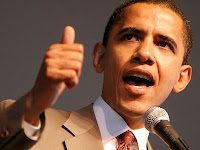
Barack ObamaThere was a popular song years ago that went " Who let the dogs out?" And that's a question that's apropos this week in the media. The answer is President Obama let the dogs out in his recent speech in Milwaukee. Alluding to his opponents he said, 'They're talking about me like a dog." What does this tell us? Language reflects thought. While some studies state that words are only 7 per cent of the message, words are powerful. They give us insight into what the speaker believes and feels. In this case, Obama is saying he feels like a victim. The key is the wording "They're talking about ME". It's something that is happening to him. It's not the language of leadership. There is a difference between being genuine and appearing weak. Former Mayor Giuliani showed genuine sadness during the bombing of the World Trade Center but he never spoke like a victim.

The dog statement was not written in the speech. He acknowledged that he went off message. When giving a formal speech that's televised it's best to stick to the script especially if the speaker is in an emotional state. Otherwise, you might end up in the dog house.

How is a Magazine Ad Like Public Speaking?

I was on the ferry this morning reading the paper and having my green tea when I was distracted by the woman sitting next to me. She was aggressively ripping out pages from a magazine. I looked at the pile of pages next to her to see if there was any pattern to her choices. They seemed random- a page of text, a good looking male model. Curiosity finally got a hold of me as I leaned over and asked, "Are you creating a vision board?" She paused for a moment as if trying to process what I had just said. "No, " she explained, "I'm pulling out the ads. It makes it easier to read." She went on to say, "It's disturbing to realize the magazine is mostly ads." She was right. I find those paper pull-out ads to be annoying and they make turning the pages difficult.

What a novel way to read a magazine! I'd never seen anyone prepare to read. Yet, that woman on the ferry was more prepared than many of the presenters I observe.

And it made me realize something about speaking. Those paper ads are like non-words in a speech. Those irritating fillers such as "um", "you know," "ah", "like" are everywhere. Non-words are analogous to those annoying ads in magazines that prevent you from reading the article or even finding the article with ease. Non-words, like ads, are distractions that blur the message.


What are you doing to prepare your audience to hear your message?


How are you weeding out non-words that distract from your content?

If everybody practiced their presentations out loud and determined where they inserted non-words, they could then write reminders in their notes and verbally tear out those insidious fillers. When you use non-words you lose credibility even if you're a subject matter expert.

Last week I reconnected with a woman I hadn't seen in years. We figured out that she had attended my Learning Annex Class on How to Give a Knockout Presentation in year 2000! She confided that I had inspired her and that she still thinks of me. How did I inspire her? She said, "You told us never to use non-words and since that time I stopped saying /um/. I tell other people to stop doing it."

Well, apparently, it made a big impact on her presentation as she is now being called as an expert in the media and doing a terrific job. Think of non-words as clutter. Just as we don't like ads in our magazines or commercials on TV, your audience doesn't like hearing a cacophonous trail of ums and ahs.


What Does a Toll Booth Have to Do with Public Speaking?

On Friday I was driving home from a coaching assignment in New Jersey. I was on the Garden State Parkway which has a number of toll booths. At the second toll booth, I extended my hand and gave the toll collector a dollar. She waived me on. I remained there not understanding. She said, "The person before you prepaid your toll." I was surprised. It was so unexpected that I couldn't process it at first. Why me? I tried to figure out through the Law of Attraction what was different this particular day that I had attracted such positive energy. All I knew is that I felt good. I was flying high. It was only a dollar but it wasn't about money. It was about the gift. It was about feeling special. The feeling lasted over the weekend as I called friends to tell them about this random act of kindness.

It got me thinking about what I teach in my speaking and communication seminars.

It's the little things that make the greatest impact.

Speakers overwhelm themselves trying to make bold changes. They think they have to completely remake themselves and achieve the equivalent in a Ph.D in Public Speaking. All it takes to make an impact is the little things-an extended pause, holding eye contact a bit longer, expanding a gesture, using an analogy, telling a personal story, standing up straight, breathing before you speak, holding a positive image before your presentation, bringing your intonation downward at the end of a sentence, smiling.

These are simple, little things that when activated, can make a big impact on the audience. The impact of my experience at the toll booth was worth so much more than a dollar. Don't discount small steps. You never know the affect they will have on not only you but your audience.

The Powerful Rule of Three

number 3For years I've talked about the power of three's. I advise my clients to present 3 agenda items, 3 main points, and 3 benefits. People remember things in three's. Karl Bryan does a good job of this in his recent email, Anatomy of Growing a Business. Consider speaking in threes as verbal bullet points. Now imagine Karl is presenting this out loud. It would be easier for the audience to remember. But you be the judge. Here is his email:

I want to recap on the ideas we've gone over through the business development lessons and essentially the anatomy of a growing, thriving business.

An entrepreneurial fallacy, is an assumption that anyone can succeed at business with: • Desire • Some capital • Projected a targeted profit

There are essentially three key roles that need to be filled to set your business up for success: • The Mechanic • The Manager • The Entrepreneur

The four different stages of a business life cycle are: • Infancy • Adolescence • Growing Pains • Maturity

There are a few basics to know about Franchising: • Business Format Franchise • The Franchise Prototype • Franchise Prototype Standards

There are three main areas of business development: • Innovation • Quantification • Orchestration

7 specific areas you need to consider in your franchise prototype process: • Primary Aim • Strategic Objectives • Organizational Strategy • Management Strategy • People Strategy • Marketing Strategy • Systems Strategy

Wasn't this format easier to follow than reading a lot of long sentences? It's especially true for speaking.The best speeches are written for the ear, not for the eye. Creating a speech or presentation is as easy as 1-2-3. That means simple language, concise statements, and colorful words.

Are You Embarrassing Your Team?

As I continue to share success stories from my living laboratory this month, I recall working with Bill for a Just-in-Time coaching session. Situation: Bill, a bright, young entrepreneur, was a Managing Partner of a software company. He was on his way to the West Coast to deliver a presentation when he called me for some coaching. His company was positioned to sell their start-up to a large organization. His partner was concerned about their image because Bill was such a terrible presenter. How often are team members or partners embarrassed by how they present themselves and the company brand? I explained to Bill how important it was to be visible and to get out there and speak. As an owner of the company, he was the face of the organization and people wanted to hear from him. Bill was motivated to change.

Solution: I worked with Bill on his transitions. We reduced the number of slides in his PowerPoint presentation, got him to slow down his speaking pace, and coached him to connect eye-to-eye with the audience. These were all small changes but like many speakers and presenters he was unaware of how to change. He didn't require a major make-over to be effective.

Result: After only TWO HOURS, Bill had transformed his image. He faxed me the results of his first speech and the results after coaching. He went from scoring a 2.6 on his audience evaluations to a 4.0 on a scale of 1-5. Audience members praised his presentation as "entertaining," "informative," and "clear." Bill confided that the meeting planner withheld the evaluations from his first speech because they hadn't been very good. His partner in the firm was blown away by the transformation! As I always say, It's the little things that make the greatest impact.

For public speaking tips visit http://www.atozpublicspeaking.com

They're Just Not That Into You

I've coached a lot of speakers and I've seen more speakers than I can count. And I've discovered that there is more to great speaking than excellent platform skills. We've all seen speakers who have perfect timing, never say um, have a well organized speech and exude confidence on stage. Yet, there's something the audience doesn't like about them. It could be air of arrogance, they may appear slick, or their words sound pretentious. If the audience can't connect they don't like the speaker. After working with so many clients and speaking to numerous groups I started to realize that people's success depended on how well they were liked. According to a Yale University study, people gain success not by aggression but by being nice. Being respected is good; being liked is even better. Juries award higher compensation to people they like. The most likable candidate usually wins an election. During the Democratic primary,Hillary Clinton's likability surfaced as an issue. Obama was perceived as more likable and won. During tough economic times, when a manager has to choose who gets a pink slip it won't be the the employee who is most liked. Employers hire people they like, clients do business with people they like, and sometimes likable students may even get a higher grade. So, if you want your message to be heard, if you want to influence, you've got to be liked.

What is likability? Find out in this video. http://www.youtube.com/dianediresta#p/u/0/wZd4Az8eDnE

Did BP's Chairman Diss the American People?

Carl-Henric Svanberg, Swedish Chair of BP was blasted for his comment about "small people".Here is what he said:

..."He's frustrated because he cares about the small people and we care about the small people. "I hear comments sometime that large oil companies or greedy companies that don't care but that is not the case in BP. We care about the small people."

Had this been said by an American it would have been condescending;however, Mr. Svanberg is Swedish. English is a second language. He was referring to President Obama's frustration about the impact on the people in the Gulf area and he was saying that he shares his frustration and concern for the people.

When it comes to communication, there is a sender and a receiver, an intention and an effect. My belief is that Mr. Svanberg's intention was to show concern for the common man and to convey that they are sorry for the oil spill and it's impact.

The effect was to trigger emotion and a feeling that he was talking down to the citizens. Two words-"small people"caused this reaction. And that is the power of language. Language and culture don't always translate. When the Chevy Nova was introduced in Mexico it didn't sell. NOVA in Spanish translated into" No Go".

It would have been more effective if the Chairman had used the terms, American people, people in the gulf region, or the workers. When listening to words we also need to listen for intention. And when somebody is speaking a foreign language, understand that there will be miscommunication.

http://www.youtube.com/watch?v=th3LtLx0IEM

7 Tips for Speaking Internationally

It’s a global world and eventually you’ll be speaking to an international audience. At the very least, the global world has come to you. Most cities have become multicultural workplaces. I’ve spoken in Africa, the Caribbean, Europe, the Middle East, and South America and although people are the same everywhere, the way we communicate is different. Here are some tips I’ve learned along the way to be successful when speaking internationally.

1. Study the Culture. Learn the protocol to gain trust and avoid miscommunication.

Know whether you should shake hands or bow. Know the policy on gift-giving. A good book on International protocol is Kiss, Bow or Shake Hands and the new book by Jan Yager called Grow Global.

2. Meet the Translator. Will they use simultaneous or consecutive translation? Did they study British or American English? Explain all idioms in your speech. It makes a difference.

3. Speak Slowly-even more slowly than usual. When English is a second language it takes longer to process and translate into their own language.

4. Use Body Language Carefully. You can unintentionally insult the audience with certain gestures. You would never expose the sole of your shoe to an Arab audience. And the A-ok sign in the U.S. is an obscenity in Brazil.

5. Speak the Native Language. The greatest rapport builder is to say a few words in the native tongue. The best time to do this is in your greeting. When I spoke in Tanzania, I said, "Good morning. I’m happy to be here" in Kiswahili. The audience broke into applause. Little gestures have great impact.

6. Avoid Humor. Even if you’re naturally funny, it just doesn’t translate across cultural and language barriers. Stick to your message but do smile. Smiling is a universal language of good will.

7. Learn their Idioms. Don’t assume that because you’re addressing an English speaking culture that you speak the same language. You don’t. I learned this the hard way. When addressing a company in the U.K. I told them that these management skills could be used “on the job.