Public Speaking

Confidence is King

I just read an article from James Caan, CEO of Hamilton Bradshaw, entitled, Confidence is King. He writes:

"Ask any businessman or woman and they will tell you the same thing – confidence is a vital ingredient in the recipe for success. In other words, if you want to be really good at anything - no matter what walk of life you are involved in - you need to have belief in yourself and your abilities."

I work with leaders to build confidence in all their communications and the biggest hurdle is fear of speaking. So I created a series of videos on my YouTube channel for conquering fear of public speaking:

Why Public Speakers Fail

Professional speakers who are satisfied with the status quo will surely find their audience slipping away. Just like the car replaced the horse and buggy, dynamic, interactive presentations are replacing the talking head. Today, public speakers have to play a bigger game in order to give a Knockout Presentation. In a recent article entitled, Why Leaders Fail, the author cites the number one reason leaders fail and it's because they believe past success equals future success. There's a lesson here for public speakers and presenters. The article made me think about some of the public speakers I've heard. And just like in leadership, the rules of public speaking have changed. I've observed public speakers using an old time, one-size-fits-all presentation style. But what worked in the past, won't necessarily fly in today's market place.

Today's audiences are more sophisticated and demanding than ever before. The old, traditional method of the expert keynote speaker with the passive, listening audience, is an old model. Technology and social media have changed the game. Today, speakers engage their audience by using live polling for just-in-time responses, encouraging tweeting content, and interactive activities, even with large audiences.

Speakers have to look at their expertise differently and more creatively. It's not enough to be a standup keynote speaker. Today's savvy keynote speakers distribute their content through many media channels: podcasts, mp3 programs, white papers available on their websites, pre-program questionnaires or surveys, downloadable handouts, and youtube video clips. The focus has changed from "speaker-as-expert" to audience engagement and tapping into the expertise of the audience.

You can still take a horse and buggy ride, but it won't get you very far. If you want your presentation to have impact, you have to shift gears from giving a speech to taking a ride on the interactive highway and giving the audience an experience.

Les Brown Tells Professional Speakers to Surrender to the Story

Les Brown and Diane
Les Brown and Diane

I was the co-chair of the Les Brown mega event sponsored by the NYC chapter of National Speakers Association on February 15th. Les mesmerized 150 audience members as he taught us how to tell transformational stories that change lives.

Les Brown is one of the top celebrity motivational speakers and made a rare appearance for the benefit of local professional speakers.


Les Brown and Marquesa

Les Brown and Marquesa

In the afternoon session, he gave an interview from the stage and spoke about the business of professional speaking. Les warned professional speakers that focusing on back-of-the room sales is the wrong strategy.

"It's impact that drives income," he explained.

People have emotional memory. While content is important, it doesn't move people to action.  When speakers create impact through stories and passion, the audience will want to do business with them. A powerful public speaker creates special moments. The best public speakers create an experience for the audience.

Les revealed that "the power is not on the stage; it's in the seats." He spoke about the rhythm of speaking and advised public speakers to pay more attention to listening than to their speaking.

"Never let what you want to say get in the way of what the audience wants to hear," he stated.

His passionate presentation flowed seamlessly, appearing effortless and spontaneous. But he demonstrated that there is a structure to storytelling and public speaking. Using his storytelling structure of It's Possible, It's Necessary and It's You, he demonstrated how he could use this template for any industry.

He taught a storytelling technique calledpivot and bridge. He then demonstrated the skill using story topics from volunteers in the audience. "Never make a point without telling a story and never tell a story without making a point." But this doesn't give public speakers license to drone on. Les explained, "The best speakers use the fewest words to go the furthest".

Les left the audience of professional speakers, toastmasters, and guests cheering on their feet and wanting more.

"The goal of a speaker is to give the audience a larger vision of themselves", he said. "Surrender to the story and speak from the heart."

Press Release: Get Ready to Give a Knockout Persuasive Presentation

Presentations-Unleashed.jpg

For Immediate Release Diane DiResta's webinar, Give a Knockout Persuasive Presentation, is one of nine classes in the MarketingProfs Telesummit, Presentations Unleashed: Inform, Persuade, Inspire

New York (February 14, 2013) -- Diane DiResta, founder and CEO of DiResta Communications, Inc, was contacted by MarketingProfs to do a seminar as part of their Telesummit, Presentations Unleashed: Inform, Persuade, Inspire. DiResta's 60 minute webinar, entitled "Give a Knockout Persuasive Presentation," will go live on the website beginning February 14, 2013 at 12:00 noon EST and will be available as part of the course for 12 months.

Click here to read full Press Release.

Lincoln's Public Speaking Secret

Inaugural speeches come and go and most of them are quickly forgotten. But we all seem to remember Lincoln's Gettysburg address. What did Lincoln know and do in his speech that the other presidents didn't consider in their speeches? One word-Brevity. When the listeners glance at their watches and their eyes glaze over you know you've lost them. The best way to keep your listener's attention is get to the point-and do it quickly. Here are some quick tips to help you sound presidential and get to the point.

Set it up. One of the biggest speaking mistakes is starting with details. Technical speakers often fall into this trap. Begin with a purpose statement.

Point of view plus two. Give them a road map by providing a two or three point agenda. Why two or three points? They're easier to remember. An agenda is a road map. It tells them where you're taking them.

Spell it out clearly and concisely. Flesh our each agenda item with examples and data but keep it brief.

Bring it home. Summarize your main points. Don't leave them hanging. Review where you've been. Bring back your main message points and end with a call to action or an inspiring statement.

When you follow these steps your listeners will enjoy the destination AND the journey.

I've Got the Power: How to Feel Powerful As a Public Speaker

amycuddystill.jpg

You may be about to go on stage to speak before a difficult audience. Maybe you're getting ready for a job interview. Or you could be about to present at a high stakes meeting. There is a way you can automatically feel powerful when speaking in public or giving a presentation. It's all about mastering body language. Yes, there is a body language of power. I'm not talking about "posturing" and psyching the other person out. Power is about putting your body into certain positions before you enter the presentation room. There's a science to body language and power. Amy Cuddy, a social psychologist, explains how to go from powerless to powerful and it's all in your control. Watch her TED talk to learn how these positions can make you a powerful leader, public speaker, or job candidate.

Words Will Die. 2013 Communication Trends

Words are dying.

According to 2013 communication trends research by Davis & Company, words will die. What does that mean for speakers and their presentations? And what will replace words?

Obviously, we won't stop speaking. But visuals will rule. And I don't mean PowerPoint. Pinterest is the fastest growing social media platform.It's usage has increased 1000%.

Engagement on facebook increases 100% when posts are visual. Photos, videos, and infographics have more impact and are quickly making written text outdated.

When coaching transitioning executives on their elevator pitch, I often go to the white board to draw visuals. Instead of scripting words, I use graphic facilitation to create visual cues (graphics, symbols) to  build a storyline and help them remember their core messages.

The transformation is amazing! Suddenly, their presentation flows as they stop struggling to remember the written words. Their presentations become conversational as the visuals serve as concept cues. The job applicant or presenter sounds natural instead of scripted. Graphic facilitation is also effective in leading groups toward a common goal and is becoming more popular for strategy sessions. The facilitator organizes information spatially and visually.

Presenters who use graphic facilitation will increase audience engagement, big-picture thinking, and group memory.

Change the way you communicate or get left behind. Improve your presentation, remember more, and stop reading your notes. Leave a message in the comment box  to learn how to use graphic communication to be a better presenter and to engage your audience.

TEDx Silicon Alley Tells Public Speakers to Keep it Simple

TED.com stands for technology, education, and design. Some of the top and most innovative public speakers can be seen on youtube giving an 18 minute presentation on new and creative topics. It's very competitive to get a speaking slot at a TED.com event, so many presenters are opting to organize and speak at local events called TEDx. I recently attended the TEDx Silicon Alley event in New York City. The theme was "Rise of the Machines," but what stood out to me was the connection between technology and human presentation. One of the presenters, Ken Segall, represented the agency that worked with Apple. He was the man credited for naming the iphone and ipad. He spoke about Steve Jobs and his focus on the simplicity principle. The presenter showed an effective ad for McDonalds coffee. It stated: Any size for only $1.00. It was elegant in it's simplicity.  Da Vinci said, "Simplicity is the Ultimate Sophistication."

I continue to focus on the K.I.S.S. principle when I speak to audiences. Whether you say Keep it simple stupid, or Keep it super simple, it's not easy to do. When I coach public speakers I tell them to create a short and long version of their presentation. They discover that's it's easier to create a longer presentation. As Ken explained, "Simple can be harder than complex".

My clients realize they have to work harder to get the message clear enough to be simple. They quickly learn that I act as "the lowest common denominator". These presenters must be able to speak so that I understand the message without being an expert in their industry. One presenter told me that when he worked in a law firm they would give a memo or letter to the assistant to read. If she didn't understand it, they rewrote the letter until it was clear.

The more complex the idea, the crisper the message needs to be. This is especially critical when speaking to the media. Professional speakers have a harder time with media training. Motivational speakers are master storytellers so they must make a shift in their presentation. I show them how to speak in sound bites. The average sound bite is about 10 seconds. If it's not short and simple, it won't land and the audience will check out.

Many of the TEDx Silicon Alley speakers focused on technology, from text to speech to algorithms to flying robots. Whether it's face-to-face or virtual, we can't get away from the need for good presentation. How do you tie these two worlds together? The thread that runs through both is simplicity. Steve Jobs said it best when he said about simplicity: "it's worth it in the end because you can move mountains."

Why the Early Bird Speaker Catches the Worm

When I first started out in my speaking business, I was hired by American Management Association to give public seminars in public speaking and presentation skills. One day, the program director sent around a memo stating that all AMA presenters were expected to arrive early to the class. It was not acceptable to show up at 9:00 a.m. What? Who would do that? I always arrived an hour early.

To be a good public speaker or presenter, you need time to set up the room.

When the curtain rises on a Broadway show, all actors are in place. But they don't show up 5 minutes before curtain call. There is a lot that goes on behind the scenes of any performance. In addition to getting into costumes and makeup, actors warm up their voices and review their lines and staging to make sure they get it right onstage. The same is true for public speakers.

As a keynote speaker, facilitator, or trainer, you are giving a performance. What happens before the presentation is as important as the live presentation delivery. Master public speakers know that successful speaking is 90 percent preparation and 10 percent delivery.

So the next time you give a speech or presentation, arrive early. Practice the presentation in the empty room. There's something about getting the feel of the room that can boost your performance. Use the time to do some deep breathing and to visualize a positive outcome. And then get ready to greet every person who enters the room. This will create a positive tone and talking to people before your speech will reduce nervousness. It will also help the audience feel comfortable with you. Next time you're tempted to breeze in at the last minute, don't!

For a free checklist on what to do before, during and after a presentation, Like our facebook page.


The Power of One Voice

Josephine "Jody" Prestovino single-handedly brought missing federal supplies to Staten Island, New York by using her voice. Jody lost her home during hurricane Sandy and spoke on behalf of her own community with no media training. She looked directly at the camera and said, "Obama promised to cut through the red tape, but we've seen nothing. Nobody is here." It's because she spoke with conviction and passion that she had an impact.

Because she spoke out, supplies started coming in. Janet Napolitano wanted to speak with her personally. My husband and I ran into her in a local coffee shop in Staten Island and congratulated her on her leadership and presentation. Everyone is a leader, everyone is a public speaker - when you speak from conviction and passion. When you do a good job as a public speaker or presenter, you'll be invited back. Such was the case for Jody. You'll see in this video the reporter asks her opinion. Her emotion and passion are still evident.

Where do you feel great passion? That's where your power lies. Speak from that place and you'll move mountains. It only takes the power of one voice.

Here's a link to her interview on NBC: http://www.nbcnewyork.com/news/local/NYC-Marathon-Post-Storm-Resources-Mayor-Bloomberg-Defends-Decision-177019721.html

So You Want to Give a TED Talk

TED talks are going viral and they're raising the bar on public speaking. TED stands for technology, entertainment and design. These videos feature some of the best public speakers who are spreading the most compelling content and ideas. It's tough to be selected as a TED speaker. So on a community level, presenters are forming local events called TEDx. Jeremy Donovan, the speaking sherpa, organized his own local TEDx event and shared his experience and secrets to being a TEDx presenter. Anybody can organize a local event. The caveat is that an organizer cannot be a speaker for the same event.

Donovan, who's been a TEDx organizer and speaker told the audience that speaking at TED is all about the story. Not every TEDx presenter is a top speaker but the one thing they all have in common is an inspiring story. He shared his formula for creating stories. Citing the movie Star Wars, Donovan deconstructed the hero's journey as a typical structure for inspirational stories. The two most important elements that are consistent in the highest rated TED presentations are storytelling and humor. He advised using humor within the first two minutes of your presentation.

While all TED talks are timed for 18 minutes, a TEDx talk can be 3 minutes, 5 minutes, or 18 minutes. Donovan gave one speaker a 5 minute slot because he wanted the audience to hear his story while protecting him from a lack of platform experience.

A big mistake first time motivational speakers make is to extol their own virtues. He warned that the audience must be able to relate and that being humble goes a long way.

How do you get selected for a TEDx talk? As in life, networking is the best way to make contact with an organizer. The interview process may require a video of your presentation as well as a marketing platform. When Donovan was an organizer, he expected presenters to have at least 500 linkedin contacts. As in publishing, the TEDx organizer needs help in promoting the event.

Can anybody be a TEDx speaker? Probably not-unless they have an inspirational idea worth spreading.

What's Your Speaking EQ?

Most discussions about emotional intelligence talk about communication and controlling emotions in the workplace. But rarely, do I hear about public speaking in regard to emotional intelligence. Yet, public speakers who present with high EQ tend to be more successful and are more engaging to the audience. Here's a simple tip from Jeanne Sullivan. In every presentation Jeanne aims to "tell them something they don't know and to make them laugh." This is a good public speaking goal for any presenter at any level. When you make an audience laugh you are tapping into your EQ skills because laughter accesses the emotions. Watch this video to learn about your public speaking EQ.  

Obama Needs to Fire His Debate Coach

The first presidential debate on October 3, 2012  belongs to Mitt Romney. It was a clear win in terms of content and delivery. Both candidates began cordially and gracefully. The President acknowledged his wife on the evening of their 20th anniversary. Mitt Romney also congratulated him and quipped about how Obama probably didn't want to spend a romantic evening on stage with him. Both candidates are skilled public speakers. They each looked presidential but Romney owned the room with his rapid fire responses, his knowledge of the facts, and his aggressive approach. He seemed more relaxed and natural and was finally able to humanize his image by talking about people he had met on the campaign trail and correcting any inaccuracies about his policies. What was especially effective was his ability to speak crisply as he quickly enumerated three to four points he wanted to make. He made direct eye contact with Obama and his passion was evident. Gone was his robotic delivery.

What was missing last night was President Obama's trademark confidence. He looked downward as Romney was speaking. His body language was weaker than expected and he would have been better served by standing with his shoulders back and making direct eye contact. He still needs to speak more crisply to be more impactful.

The real loser in this debate was Jim Lehrer, an accomplished journalist and moderator who seemed to be off his game. He acknowledged they had gone over their time and Romney seemed to take advantage of Lehrer's loose time-keeping.

As in any speech, or media presentation, public speaking skills are very important. But visual images can send a strong message. At the end of the debate, Michele stepped on stage to greet her husband. At the same time, Romney's wife and five sons joined him on stage for a victory hug creating an image of strong support.

Romney won the first debate on domestic policy. Will he be able to keep the momentum in the second debate? Will Obama rise to the challenge? What do you think?

Adrian Miller Speaks About Growing Your Business

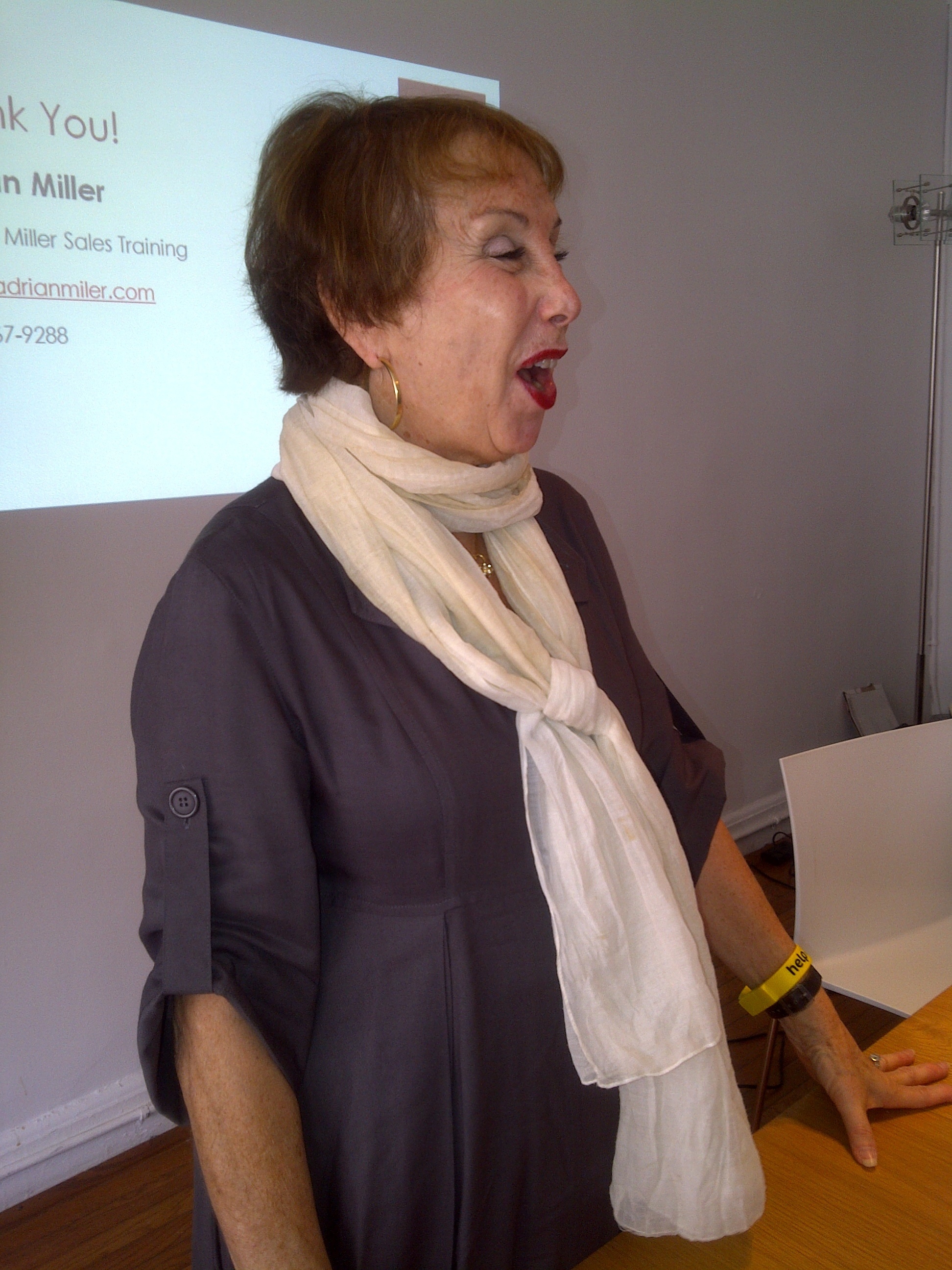
Adrian Miller rocked the audience this morning when she gave a knockout presentation entitled 4 1/2 Ways To Grow Your Business. As a public speaker Adrian was dynamic, pragmatic, and drove home her message with humor. Her tips for increasing sales were appropriate for public speaking and giving presentations. Her 4 1/2 tips included:

1. Be Different 2. Stay on the Grid 3.Qualify 4.Probe 4 1/2. Quantify everything

So how does this relate to presentations? Speakers who are different are memorable. But being memorable isn't enough. You must stay on the grid. Speakers can stay front of mind by sharing ideas and information that add value to their customers and audience. It's important to qualify the audience by conducting a listener profile. The more you know about the audience the more effective the presentation will be. This involves the use of probing skills prior to the presentation. But masterful presenters probe the audience during the presentation by taking a quick poll to create engagement. Finally, be sure to survey the audience so you can quantify results. You may have a good feeling about your speech but don't rely on gut feelings. To measure your speaking performance it's better to compile audience comments and a numerical rating scale.That kind of process will give any public speaker real time data that can be quantified.

So why did Adrian give 4 /12 tips? To be different! Weren't you curious about the 1/2 tip? What have you done as a presenter to differentiate yourself from other public speakers?


Your Message Has Value But Does It Have Impact?

  On Friday, Ford Saeks spoke to the New York City Chapter of National Speakers Association. He presented marketing tips and presentation tips for delivering a knockout elevator speech to an eager audience. He then asked for a volunteer and demonstrated how to create an elevator speech that has impact. The difference was dramatic. Public speakers and networkers get bogged down explaining the details of their services.

He cautioned, "It's not what you do it's what you offer." Ford, a business growth specialist and professional speaker, advised the audience of speakers to "Give away the WHY and sell the HOW TO." He believed that all marketing techniques work if you do it right.

One of the reasons a presentation doesn't have impact is because the writing isn't emotionally authentic. He reminded speakers to sell value. Ford's presentation was full of valuable tips. He held a contrarian view of marketing success. "You don't need money to make money," he countered. "Ideas make money. You need value to make money."

When writing presentation copy, Ford told speakers to list all the problems they solve and then write content related to problems they solve for their clients. The goal in presentations is to speak from the listener's point of reference. Then the message will not only have value but it will have impact.

Networking Presentations Are Not Just for Speaking

Speaking is the new competitive advantage. I wrote two blog posts about the importance of good public speaking skills when giving an elevator speech and talked about keeping it concise and compelling. I belong to two networking groups - Gotham Networking and Adrian's Virtual Network. Both groups have a listserv which I use often. Once a week, a member can promote their business by sending a written elevator speech to the listserv. Most of these presentation showcases get lost because they are:

  • too long
  • too confusing
  • too cluttered

Here's a recent written elevator speech by Michael Spadaro that is simple to understand and well formatted. Notice the use of numbers, bold, spacing, hyperlinks, and contact information.

How hard is it for growing businesses to find an IT partner that is not only competent, but also trustworthy, responsive, and a pleasure to work with?  It's hard- really hard.  Unless you're reading this e-mail.

In the interest of brevity, here's what we do:

1. We help business make smart IT decisions

2. We act FAST to solve day-to-day IT problems

3. We keep IT running smoothly ("like buttah")

Our clients are businesses (typically 5-50 employees) that:

1. Are Growing

2. Are Efficient

3. Value their Time

Our creds:

1. We've been doing this for 5 years, which means we've been doing it long enough to master our craft, but not so long that we're in danger of being out of touch.

2. Our customer service has been recognized by many as being among the best in the industry.

3. We've got an army of enthusiastic clients who are willing to speak on our behalf

Check out our website at http://www.helpwithasmile.com for more information including a rundown of our entire service offering, as well as case studies, staff bios, and more.

Michael Spadaro

Congratulations, Michael. You proved that good presentation skills are not just about speaking.

Why Romney's Presentation Failed And What He Can Do About It

The political stage is a fascinating study of the power of the presentation. When it comes to public speaking and media training, Romney has two areas to address. Unless he can improve these two areas, he will plummet in the polls.

The first area is language.

Romney's recent remarks which were secretly recorded have been replayed continuously in the media. He stated, "There are 47% of the people who will vote for the president no matter what." If Romney had made that one statement his presentation and media image may have been salvaged.

His presentation derailed with this next statement.  "There are 47% who are with him, who are dependent on government, who believe that, that they are victims, who believe that government has the responsibility to care for them. Who believe that they are entitled to health care, to food, to housing."

His first statement that 47% will vote for the president is a marketing decision. He's saying that's not his target market. In any campaign, the candidate or marketer will focus time, effort, and money where there will be the greatest return. In other words, he knows they're not his fans.

The second statement felt like an attack and many people reacted negatively. Given that part of the 47% are elderly it sounded callous although that was not the intent.  A good media trainer would advise him to quickly apologize for misspeaking and to reword his statement. The challenge for all politicians and any public speaker in the limelight is that the media can take one soundbite and kill your reputation. Persons in the eye of the media must remember that they are always being recorded and that even speaking one-to-one is public speaking.

Remember when Jessie Jackson was a presidential candidate and made a religious slur in New York City? He was talking to an individual and someone in the crowd overheard him and reported it. Although he wasn't recorded, it had the same effect on his presentation and reputation.

For the non-famous public speakers, once you leave the stage, you're forgotten. But if you're a politician the media will replay and spin your presentation into the stratosphere.

The second area is delivery.

Romney looks and speaks like an executive. But like Al Gore, he appears stiff. When he says he cares about the poor and middle class the message lands as facts rather than warmth. Yet, when he's on a talk show he's more relaxed and his personality comes through. As a public speaker he needs to enhance his presentation with more self disclosure, personal stories, and more effective language. When he speaks with passion and can convey caring he'll increase his ability to connect.

These comments are non-partisan and related to the presentation of the candidate and not policies. What do you think Romney needs to do to improve his presentation in the media?



When Celebrity Speakers Fail to Deliver

Last night I was a guest speaker for ABWA. My presentation was Speak Powerfully Sell More: Speak Your Way to More Business. One woman in the audience asked a question about how to handle a celebrity who is hired to speak and doesn't deliver. This woman went on a rant about how many of these celebrities are not good speakers and yet meeting planners continue to hire them. I explained that the reason for that was event planners want to sell tickets. An event will sell out when the keynote speaker is a celebrity.

This made me reflect on my own experience at conferences and I had to agree. I recall one convention where I signed up for the lunch event  for an additional charge. The guest speaker was a well known television personality. And he was late! We had already been served the main course before he cavalierly sauntered on stage in his jeans and pec-enhanced tee shirt. I enjoyed his stories but I couldn't get past his lateness. He never made mention of it. The woman sitting next to me had booked celebrity speakers in a past job and told me that they don't care if they're late. They expect everybody to wait for them.

It seems that some celebrities don't prepare or don't know the audience. One woman media personality gave a presentation about herself and her career path. Who cares? Can you spell BORING? Some celebrity speakers trade on their name and expect to be paid just for showing up.

A number of years ago, I was hired by the National Basketball Association when they launched the NBDL (minor league team). My job was to media train the team presidents and media relations people of these newly formed teams. The media training was well-received. One woman thanked me and said that she had recently been part of the Olympic committee. The committee brought in the "big gun" media trainers who were television anchors. She confided to me that these anchors "Just showed us videos and told us stories. But you showed us how to do it."

Once again, it's all about perceived value. I'm sure I made a fraction of what they paid these anchors. But because of their celebrity status, they were considered excellent media trainers.

So what is the solution? How can meeting planners and speakers bureaus ensure that the celebrity speakers can deliver? They can't.  Some guest speakers have a good reputation for consistently delivering a great keynote speech. Hire them. But let's say you want a particular celebrity for your meeting because you'll sell out your event, but you know the speaker doesn't have very good platform skills?

Don't give the celebrity the keynote speech. Instead, feature them as the main event for an interview on stage. Conduct the interview "Charlie Rose" style. Then hire a professional speaker who can wow the crowd or has strong content. The audience will get exposure to the celebrity or guest, the celebrity's ego will be intact as the main act, and you won't lose your reputation as an event planner.

When it comes to meetings and events, public speaking skills matter. The event is only as good as the speakers. The audience will pay to hear a celebrity, but if he doesn't deliver, they may not come back the next time.

If you book celebrity speakers, I'd love to hear how you ensure that they will deliver on the platform. And what do you do when they disappoint the audience? Would you hire a celebrity speaker the next time? Or would you try a less known presenter or entertainer?

New York Author Says "Speaking is the New Competitive Advantage

PRESS RELEASE

For Immediate Release

Contact: Diane DiResta

Phone: 212.481-8484 x 312 Web: www.diresta.com Blog: www.diresta.com/blog

September 12, 2012

New York, NY -Diane DiResta  will present " Speak Powerfully Sell More: Speak to Grow Your Business" at the New York Chapter of the American Business Women's Association tonight at 6:00 p.m.

Recognized for her public speaking and media training expertise, Diane DiResta, author of Knockout Presentations and President of DiResta Communications, Inc, was invited to speak at the ABWA.  The event, held on Wednesday, September 12th  at Phillips Nizer  666 5th Avenue, targets business owners and professional business women seeking new strategies to enhance their visibility and image from proven industry experts like DiResta.

The audience will learn how to leverage the power of the spoken word:

  • Why speaking is the new competitive advantage for entrepreneurs and business professionals
  • How to develop message points and target the audience
  • Mistakes speakers make and how to avoid them
  • How to project confidence on the platform

"Businesses can no longer avoid public speaking," warns DiResta. "Clients and prospects want to hear from you. You are the brand."

Professionals are not exempt from speaking skills. It's easy for women to become invisible in organizations. Public speaking levels the playing field. One executive woman was being overlooked when DiResta first began coaching her. Today that executive  has increased her profile by speaking internally and externally, and was recently on the cover of a prestigious industry trade publication. "Speaking is a leadership skill,"  explains DiResta.

DiResta, who is both a professional keynote speaker and executive speech coach, believes anybody can be effective in delivering a message.  An advocate of speakmarketing, she will share with the audience her experience and success leveraging public speaking as a marketing tool. Her own speaking strategies have resulted in paid speaking and consulting assignments in places such as Tanzania and Egypt.


About DiResta Communications, Inc.

Diane DiResta is president of DiResta Communications, Inc., a New York City consultancy serving business leaders who want to communicate with greater impact — whether face-to-face, in front of a crowd or from an electronic platform.  DiResta is the author of Knockout Presentations: How to Deliver Your Message with Power, Punch, and Pizzazz, an Amazon.com category best-seller and widely-used text in college business communication courses. www.DiResta.com


911 for Presentations and Public Speakers

Today marks the eleven year anniversary of 911. I remember it like yesterday. It was the nicest day of the year. There was a noticeable stillness in the air. I headed off to JP Morgan where I was speaking to a group of relationship managers in the private bank. The seminar was on sales presentation skills. We began at 8:00 a.m. A participant arrived late and told me the World Trade Center had been hit by a plane. Thinking this was a fabrication for his lateness I was a bit skeptical. When someone else confirmed his story, I called a break and we all marched out to the lobby in search of a television. For the next few minutes we sat in stunned silence as we watched the towers collapse. I asked the manager if she wanted me to continue the seminar and she said no. We cancelled the seminar and I left to find a hotel since certain areas were on lock down and traveling home was probably not an option.

While this is an extreme case of speaking disasters, public speakers need to be prepared for the worst. The best advice for any public speaker is to have a recovery strategy. You never know when your presentation will be impacted by an unforeseen event.

Take the case of the man who was giving a motivational keynote speech to a large audience and suddenly there was a fire in the hotel. The hotel was evacuated and all the audience members were herded into the parking lot. Did that end the speech? Oh, no. This savvy professional speaker jumped on top of a car and continued to give his keynote speech in the parking lot. He believed the show must go on.

I remember when I attended a National Speakers Association conference. There were 2000 people listening to the keynote speaker on the big stage. All of a sudden, an audience member had an epileptic seizure. The audience was now riveted on the disturbance and she realized she had lost their attention. There is always that moment when you question what is the right protocol. She called out and said "Should I stop?" She paused for a bit and when they removed the man she continued her speech. Again, these are extreme examples but they do happen to public speakers.

It's more likely that when you give a presentation you'll encounter less dramatic mishaps. The most common speaking disaster is when technology fails. The recovery strategy for technology failure is to have a back-up. Put your PowerPoint presentation on a flash drive, send an email copy to the meeting planner, and print a hard copy.

What if it's an embarrassing speaking situation? One woman was giving a speech on a stage behind a podium. The elastic band on her half slip (undergarment) snapped and her slip fell to her ankles. She calmly stepped out of the slip and continued her presentation. This would have been a good moment for some humor.

Which brings us to the best public speaking recovery strategy. Take a line from Rod Stewart's song "Her ad lib lines were well rehearsed." In other words, plan some extender lines. Let's say the lights go off. You could say, "Next time I'll pay my electric bill." But what if they continue to flicker and go off again? If you have a few lines you can extend the humor by adding a new "ad lib." One professional speaker had a technology meltdown. He had five extender lines which he used. He later confessed that he was glad that the problem was fixed after the fifth attempt because he had no more humorous one-liners.

Anticipate what could go wrong in your every day presentations. I've spilled coffee, knocked over a flip chart, and hit the wrong button on the video playback. I even lost my train-of-thought when presenting on a panel. I knew what I wanted to say but couldn't retrieve the word. My brain froze. So I simply asked the audience, "What is the word I'm looking for?" They gave it to me and that was the end of it.  When it comes to public speaking or any kind of presentation, the audience will not fault you for flubbing if you recover with grace.

Back in 2001 when my seminar was cancelled, we did recover with grace. We rescheduled the presentation a month later and the attendees performed well. They recovered emotionally and that was the best recovery strategy.

What were your worst public speaking disasters and how did you recover? What advice do you have for other public speakers and presenters?