

Public Speaking

Gifted Speakers are Born, Effective Speakers are Made and Bill Clinton is.....

Bill Clinton is a rock star on the speaking platform and the ultimate spin meister. I tell my audiences that gifted speakers are born. Most public speakers will never reach the level of a Martin Luther King. Not even most professional speakers achieve that height. Some speakers have a special gift-an ability to move the masses, entertain the crowd, speak off the cuff, and sway an audience. And last night at the Democratic Convention, Clinton demonstrated all of it and then some. As I anticipated his speech, I wondered how he was going to excite the crowds when the facts pointed to high unemployment, lower wages, and a general discontent with the economy. Well, it didn't take him long to put a position spin on the situation. How did he do it?

Purpose: Clinton stated clearly and succinctly his intention. "Now, Mr. Mayor, fellow Democrats, we are here to nominate a president... and I’ve got one in mind."

Positioning: He introduced  the President by highlighting his background of triumph over tragedy and quickly spoke of  the challenging economy he inherited. Right up front he presented the elephant in the room and established an expectation of a long road toward recovery. He quickly addressed the questions or objections in the minds of the audience.

"I want to nominate a man whose own life has known its fair share of adversity and uncertainty. I want to nominate a man who ran for president to change the course of an already weak economy and then, just six weeks before his election, saw it suffer the biggest collapse since the Great Depression, a man who stopped the slide into depression and put us on the long road to recovery, knowing all the while that no matter -- no matter how many jobs that he saved or created, there’d still be millions more waiting, worried about feeding their own kids, trying to keep their hopes alive."

Personalization: Clinton acknowledged Mrs. Obama by saying "And by the way, after last night, I want a man who had the good sense to marry Michelle Obama."

Pandering: He acknowledged the Vice-President and the President but gets his plug in for Hillary.

"Joe Biden did a great job with both. Now -- now, he -- President Obama -- President Obama appointed several members of his cabinet, even though they supported Hillary in the primary. Heck, he even appointed Hillary. Now, wait a minute. I am -- I am very proud of her. I am proud of the job she and the national security team have done for America."

 Provoking: As expected he took shots at the opposition, but here he provoked emotion. "I often disagree with Republicans, I actually never learned to hate them the way the far right that now controls their party seems to hate our president and a lot of other Democrats."

Passion: True to form, nobody can accuse Bill Clinton of low affect. From his broad, sweeping gestures to his finger pointing, from his direct sustained eye contact, to his powerful and emotional voice, passion is his middle name. It doesn't matter whether the facts are on his side or whether he omits information. People believe him because he's able to stir their emotions and whip up excitement with his strong conviction and confident delivery. He's a natural off the cuff speaker which gives him that folksy speaking quality. This is a public speaker who is never at a loss for words and always goes over his time limit.  (I must confess, I went to bed before the end of his speech).

A true public speaking master, Bill Clinton used all the rhetorical devices without making them sound like techniques. Like him or not, call him a snake oil salesman if you will, Clinton is the poster boy for persuasive presentations.
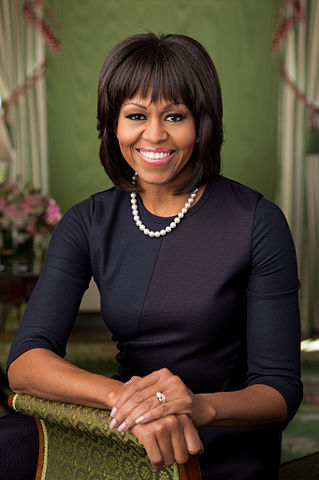

 

Michelle Obama's Speech: Poise, Passion, Presence

This post originally appeared on September 5, 2012. Official White House Photo by Chuck Kennedy - P021213CK-0027, Public Domain

Michelle Obama gave a knockout presentation. Her speech last night at the convention wowed the crowds and she was the epitome of confidence. It began with her entrance on stage. She smiled warmly as she waved to the crowd and waited for the applause to die down. Her voice was passionate and she radiated an energy that communicated she was happy to be here. She has mastered public speaking.

Throughout her presentation, Mrs.Obama connected with the audience. She sustained eye contact throughout her speech and it was not evident that there was a teleprompter.   Too often, public speakers look nervous because of wavering eye contact or lose credibility because they look like they're reading. Strong eye contact combined with her warm smile endeared Mrs. Obama to the audience. They experienced her words as heartfelt as she described the modern day heroes she encountered in her travels.

She also leveraged the power of story and was at her best when she talked about her early life with the president and her personal concerns about giving her girls a normal life in the White House. Her shared experience of growing up with similar values like her husband's and working their way out of poverty was the classic rags to riches story that every person can relate to. It's the classic American Dream.

The speech was skillfully crafted to build from the struggles of her parents and in-laws to the current challenges and policies facing the nation. It was a subtle way of addressing issues without being dogmatic. As a parent, Mrs. Obama painted a picture of a strong family who is grappling with the same challenges that all families face.

She spoke sincerely and her challenge was non-confrontational "we must work like never before…and we must once again come together and stand together for the man we can trust to keep moving this great country forward…my husband, our President, President Barack Obama."

Mrs. Obama understood that the purpose of the presentation was not to be a politician but to show the personal side of the president and gain the public's confidence in his leadership. She maintained that balance of confident public speaking with a personal passion and warmth.

The lessons for public speakers? Prepare and practice so that your presentation looks seamless. Connect with your eyes and let your warmth come through. Speak from the heart and tell your story. The rest is just technique. https://www.youtube.com/watch?v=jUpN6klYP9o

Don't Sweat Your Speech-Take a Second Look

Today is Take a Second Look Day. That means it's a day to repurpose, reuse, or redistribute your content. It can apply to anything in your life. Since many public speakers freeze when they have to prepare a speech or presentation, I thought it would be valuable to apply this "Take a Second Look" concept to preparing a presentation. Panel Presentations Let's say you're asked to speak on a panel or to give a stand-up presentation on your topic of expertise. You're staring at a blank piece of paper and wondering how to begin. Who says you have to start from scratch? Use what you already have done. Take a look at past presentations, documents, proposals, blogs, and articles you're written. What is the main topic or theme? How can you repackage it?

If you wrote an article or white paper on Leadership Trends, you can easily turn that into a five or ten minute panel presentation. Identify the main trends, and give a short example for each idea.

Keynote Speech Next, create a keynote from the same article. Instead of listing 10 or 15 trends, take the three most important ideas and flesh them out with stories, humor, and statistics. As you present them to the audience, contrast and compare those trends to the past and present happenings. End with a call to action.

Seminars and Workshops For a seminar or workshop, the emphasis is on skills-building not ideas. Begin the first part of the workshop by introducing the top trends just as you did in your original article. Interaction and engagement are especially crucial to your speaking success when delivering a seminar. So, you can build in a quiz or matching game to test their knowledge of the trends. Once they know the trends, you'll need to speak about the skills to master those trends. After the audience learns about the trends and skills, they 'll need to practice them. The remainder of the workshop or seminar could be skills practice through videos, demonstrations, role plays, case studies, or presentations.

But it doesn't have to end there. You can further repurpose your content by recording a one to two minute podcast or video and post it to youtube.

Proposals What if you're asked to present a proposal? No sweat. Create a blank template from a past proposal. Fill in the blank sections with your ideas and data. Reusing a past proposal will cut down on preparation time. My clients tell me that using my speech writing template helps them to more easily create presentations.

Public speaking is going to continue to be a skill that is in demand. You can no longer avoid giving presentations. But it doesn't have to be difficult. The next time you have to create a speech or presentation, don't sweat it. Simply take a second look.


Public Speaking and Politics: It’s All About the Story

Last night at the Republican convention, we witnessed public speakers who nailed their presentations. What do Paul Ryan, Condolezza Rice, and Susana Martinez have in common as public speakers? Each and everyone of them shared a personal story. Susana began by telling the story of her immigrant parents.

“Growing up I never imagined a little girl from a bordertown could one day become a governor.  But this is America…My parents taught me to never give up and to always believe that my future could be whatever I dreamt it to be.

We grew up on the border and truly lived paycheck to paycheck. My dad was a golden gloves boxer in the Marine Corps, then a deputy sheriff.  My mom worked as an office assistant. One day they decided to start a security guard business.  I thought they were absolutely crazy.  We literally had no savings.  But they always believed in the American dream.”

By the reaction of the audience, it was evident that they could relate to the governor's rags to riches story.

Condolezza told of her upbringing as a Black child in the South.

“And on a personal note, a little girl grows up in Jim Crow Birmingham - the segregated city of the south where her parents cannot take her to a movie theater or to restaurants - but they have convinced her that even if she cannot have a hamburger at Woolworths, she can be the president of the United States if she wanted to be, and she becomes the secretary of state.”

Finally, Paul Ryan started to tear up as he spoke about his mother.

“My Mom started a small business, and I've seen what it takes. Mom was 50 when my Dad died.  She got on a bus every weekday for years, and rode 40 miles each morning to Madison. She earned a new degree and learned new skills to start her small business.  It wasn't just a new livelihood.  It was a new life.  And it transformed my Mom from a widow in grief to a small businesswoman whose happiness wasn't just in the past. Her work gave her hope.  It made our family proud.  And to this day, my Mom is my role model.”

Paul Ryan, along with the other speakers injected humor and poked fun at Mitt Romney. When acknowledging the generational difference between Romney and himself, he stated,

“There are the songs in his Ipod, which I have heard on the campaign bus.... and I have heard it on many hotel elevators.  He actually urged me to play some of these songs at campaign rallies.  I said, ``Look, I hope it is not a deal breaker Mitt, but my playlist starts with AC/DC and it ends with Zeppelin.” Ryan ended the speech by bringing his family on stage.

There were many effective public speaking techniques that the speakers used during their presentation-humor, passion, and repetition. But by far, the one skill that connects with an audience is the personal touch. Every audience wants to know three things: Who are you? Who are you to tell me? What’s in it for me? It’s not the facts that move an audience, it’s emotions that get them on their feet.

The audience got a look into the lives of these three presenters and got to know them on a personal level. This will be a challenge tonight for Mitt Romney who tends to be more mechanical and reserved in his presentation. He may be on top of his facts, he may have a plan for turning around the country.  But most Americans are thinking, "Who is he?" In order to connect with his constituents, he will need to connect on an emotional level. And nothing is more emotionally powerful than a personal story.


Don't Ask Me to Speak for Free!

  A couple of years ago I spoke to an organization of business owners. Their policy was that you had to give two free  three hour presentations before you could have the honor of being paid to speak. It didn't matter if you had 20 years experience, testimonials, and a good track record. The person who recommended me to speak to her group paid for my presentation out of her budget. I was not going to invest three hours of valuable content plus preparation time for free.

After a couple of years passed, I tried to log into their internet site to read some of the articles. It locked me out. So, I called them to verify my login information. They acknowledged that I had the wrong information. But I was not expecting what came next. The person on the phone informed me that because I hadn't given a presentation for them in a couple of years, I would have to start over and give two free presentations in order to gain access to their site. What? Speak for free? After I've already been paid as a speaker? I already proved myself. This was beyond nervy. It was downright offensive.

Can you imagine saying that to a plumber or electrician? They charge you a set fee just to walk in the door. And everybody pays them. Newsflash: Speakers earn their living by speaking. It's not an avocation. It's a business.That's why it's  called professional speaking.

A few years earlier I was the keynote speaker at a women's conference. A man approached me and told me he liked my presentation. He asked me if I gave this talk  for companies. They had some issues and he was interested in having me speak at a monthly meeting. He said he would check with his boss and get back to me. The next day I received his email inquiry.  He asked, "By way of clarification, is there a charge for this?"  Excuse me? I think the question is , "What is your fee for this?" Does his boss expect him to show up for free? Needless to say, my friends and I had a good laugh and I turned them down.

A speaker provides as much value as any other professional. Imagine asking an employee to give up a week's salary because they took time off? It's as if there's a testing period for a speaker. Come and speak for free and if we like you, the next time we'll pay you.

This happened to a friend of mine. She did a pro bono one hour workshop for a professional services firm. When she prospected for more business they told her that they weren't going to spend any more of their training budget this year. Why should they? They just got it for free. Now that they have her valuable tips there's no reason to hire her. This woman was a thirty year veteran who provides business strategies that result in growth.

I took her aside and told her that she was not to speak for free for any firm or business ever again  that had the means to pay and could be a client.

A few years ago I learned of a women's initiative program at a multi-national corporation. Their name is recognizable world-wide. On the one hand, they wanted to develop their women with these diversity programs but on the other hand, they didn't want to pay speakers to come in to train their people. What is the company communicating? (We have a program to develop women but it's just lip service). If a company won't invest financially, they just don't value you or their employees.

However, there may be circumstances when you'll waive your fee.

When should you speak for free or make a complimentary offer?

  1. Skills Development You're just starting out and you want to get experience as a speaker. You need to develop your platform skills. Join toastmasters and speak for free for non-profits.
  2. Back-of-the-Room Sales You want to upsell products or other services and speaking is simply the medium you 'll use to promote. You know you'll make a killing on back-of-the-room sales so speaking is secondary.
  3. Thank You You've been a trusted advisor to a client for years and you want to give a free presentation to their customers as a thank you.
  4. Charity/Community Service You're volunteering for a cause. For the past two years I've done pro bono coaching for a couple of student winners of the Financial Women's Association mentoring programs to help them with their acceptance speech.
  5. Marketing You're in front of a non-profit or trade organization and could be hired by the audience members. When I spoke for free at a national conference I was later hired to work with a company in Egypt for two weeks. That's a marketing pay off.

Never speak for free for your target client or customer. The goal of speaking for free at local associations is to showcase your services to potential clients in the audience. Public speakers speak for free. Professional speakers speak for a fee. If professional speakers don't value what they have to deliver, the market won't either.


No Boring Topics-Only Boring Speakers

It was Day One of my presentation skills seminar. I asked the participants to talk about their passion. The presenters spoke about a vacation, a hobby, a sport, an event. It was evident that their presentations improved when they spoke with passion. Next up was Elliot. I asked, "What's your topic?" He replied, "Inventory control." A bit confused, I said, "No, Elliot, It should be something you feel passionate about. What excites you?" "Inventory control," he countered. I could tell that this was going to be a LONG day. Subscribing to the philosophy, if you can't beat 'em, join 'em, I acquiesced. After all, some people just have to learn the hard way. I hit the record button on the video camera, as I anticipated his painfully boring presentation.



Well, all of a sudden I snapped to attention. Elliot was so excited about his job in inventory control. As he described what he did, Elliot was animated, passionate, and truly enjoying himself. No nervous public speaker was he. As a public speaker, he came alive and was bursting with energy as he relived all his contributions and what he loved about his job. And in that moment I had an epiphany...

There are no boring topics. There are only boring speakers.

How often do we hear people in financial services or technology use their so called "dry topic" as an excuse to be boring?  I remember coaching a manager in a large financial services company. He had to deliver numbers during his monthly reports. He would drone on and deliver digits like he was reading a death decree. The audience would fight to keep their eyes open. Yet, people who knew him socially would call him a "good time Charlie". After work, he was funny and animated but somehow he'd lost himself during financial presentations. So we used his natural humor and applied it to his presentation. In the next meeting he started with a quiz.

He wrote a very large number on the board. Suddenly people were looking up at him with curiosity. "This number," he said, "is a) the national deficit, b) my wife's credit card bill, c) the current lotto winnings, d) our projected revenues. His peers started laughing. Soon, people looked forward to his attention grabbing openings. He realized that there are no boring topics, only boring speakers.

Fast forward to today. In New York City, during my morning commute, I see free local newspapers handed out. Some of the workers simply push a paper in front of a commuter, hoping they'll take one. They think of their jobs as pushing paper.

But there was one man who caught my attention as I was going into the subway. He positioned himself at the entrance so people would pass him on the stairs. He'd move around and start chanting, "Get you A.M. paper." "Get it here." He'd bounce along as he connected with the crowd. This man was having fun. He took what could be a boring job and used his creativity to connect with the morning crowd. He brought a smile to my face. Here's someone who knows instinctively that even delivering newspapers is a presentation. Watch him and you'll know you never have to be boring again:

AM New York

Bill of Rights for Public Speakers

July seems to signify freedom. July 1st is Canadian Independence Day, on July 4th  the U.S. celebrates its birth as a nation, and on July 14th, the French celebrate Bastille Day. I started thinking about the freedoms we enjoy-freedom of the press, freedom of religion, freedom of speech.

We have this great gift of expression, the freedom to speak our minds. Yet some public speakers are anything but free. They approach the podium as if they're walking their last mile. Their bodies stiffen, their faces freeze,and their words trip over their tongues. These speakers are imprisoned by their own negative beliefs and shrink before an imagined enemy-the audience.  Well, it's time for all public speakers to assert their rights.

Public Speaking Bill of Rights

  1.  I have the right to be my authentic self.
  2. I have the right to be relaxed and in control.
  3. I have the right to smile and enjoy myself.
  4. I have the right to engage the audience.
  5. I have the right to not know all the answers.
  6. I have the right to make mistakes and recover with grace.
  7. I have the right to walk in like I own the room.
  8. I have the right to reference the slide without reading it.
  9. I have the right to own my power and not give it all to the audience.
  10. I have the right to establish eye contact and not get flustered if they don't smile.
  11. I have the right to speak with conviction.
  12. I have the right to enjoy my standing ovation!

Save Speaking Time with Rhyme

Giving a good  elevator speech is an opportunity to make  you and your company shine. But how do you stand out from all the others? Good public speakers know how to use presentation techniques such as speaking in three's, repetition, and alliteration. But rhyme? Last week,  I attended a BNI networking meeting. It was a large group and the introductions were limited to 20 seconds. It's always a challenge to be able to create a concise message which is also compelling and memorable. There were a number of clever taglines. A massage therapist said: "I won't rub you the wrong way." An accountant offered, "We make your life less taxing." A green real estate company announced, "Green sockets put green in your pockets."

But the most memorable person was Frank  Passantino, the owner of Printech Business Systems in New York City.  He stood up and in a Brooklyn "God Father"- like accent he started to rap:

I'm the rhyming Italian printer -Frankie P If you don't use me - I may Break your knee. I'm only kidding - That stuff ain't true. But some day you may end up- In a vat of hot glue. So if you don't call me - When you print the next time . I may not hurt you -  But I'll kill you with rhyme

He ended with this tagline: "We'll make you a brochure your customers can't refuse."

While Kanye and Eminem don't have anything to worry about and Frankie P is not going to quit his day job, he did get attention and laughter from the group. And he made the 20 second time limit. To be a memorable speaker you need to capture attention. While most people drone on about how wonderful they are, speaking in rhyme is a fun way to toot your own horn without blowing it. As soon as you do something unexpected the audience pays attention.

What presentation techniques have you used to make an introduction more interesting?

Entrepreneurs "DIY" (Do It Yourself) Marketing Tips

June is Entrepreneurs "DIY" (Do It Yourself) Marketing month. Speakers need to effectively market their speeches and presentations. Even if you work for a company, you may be called to speak at industry conferences and trade shows - and that means you need to promote yourself. Marketing doesn't have to be expensive. Here are some free or low cost ways to promote yourself and your business.

Marketing doesn't have to be expensive. No matter how good you are, it's not how many people you know, it's who knows you that counts. So try some of these low cost marketing tips to get your message and your name out there and make sure you know how to present yourself powerfully. When you're ready to take your presentation to the next level, click here.

Is Your Diction Distorting Your Message?

Certain speech patterns grate on people's nerves. It goes beyond a simple mispronunciation or grammatical error. Just like excessive "ums" and "ahs" in a presentation will distract your listeners, a distorted sound will cause them to focus on your diction, rather than the meaning of your message. Listen to this video to see if you have this common speech distortion - shared by both Carol Channing and former Congresswoman Shirley Chisholm:

Are You Guilty By Omission?

When a speaker or presenter leaves out a sound or a syllable, they are guilty of omissions. Otherwise known as deletions, these speech mistakes can cause the speaker to sound uneducated or unprofessional. Often, these deletions are a type of regionalism and frequently, the presenter has no idea that they omit certain sounds. I was recently asked to coach someone because her regional speech patterns were impacting her executive presence and opportunities for advancement. We discovered that omissions were one of her issues. Listen to the video to see if you're guilty of using any of these deletions.

Do You Have Additions in Your Diction?

Diction is an important part of public speaking. Mispronounced words become a distraction and your message can get lost. Effective presenters are mindful of their pronunciation. Certain regionalisms become part of the vernacular, but that doesn't mean it's correct. Inappropriate diction or sloppy speech can rob you of executive presence and impact your professional success.

Listen carefully as you watch this video to see if you make this verbal faux pas:

Even Michelle Obama Mispronounces This Word

In 2004 I was quoted in the Wall Street Journal about sloppy speech habits in the workplace. It hit a nerve and the reporter, Joann Lublin, wrote a follow up piece. It seems that employers favor good diction in the workplace. In honor of May being Better Speech and Hearing month, I'm posting some one minute videos to address the issue of poor diction. Even well spoken, high profile communicators express the occasional verbal faux pas or mispronunciation. Some of these diction errors are regionalisms;even so, they can undermine the speaker's credibility, executive presence, and leadership.

Va Bene: What the Italians Taught Me About Public Speaking

It’s been a while since you’ve heard from me. I just got back from vacation in Northern Italy. In the big cities, a lot of people speak English but in the smaller towns, it helps to speak a few words of Italian. We were in the town of Quinto, a suburb of Vicenza. While we were paying for our food, the cashier asked my husband if he spoke Italian. He shook his head and said, “No parla Italiano.

What Are Your Presentation Disciplines?

My coaching client was practicing his presentation. As he talked about the company process for managing a stock portfolio, he explained their stock picking discipline. Regardless of the portfolio manager’s expertise, it’s required to drop a stock when it dips below a certain level. In other words, they may carry big winners, small winners or small losers, but they don’t tolerate stocks that are big losers. This number or percentage is how they factor out emotions and manage risk. After explaining the stock picking discipline, he looked up and asked me, “What are my presentation disciplines?

What Seasoned Speakers Know That You Don't

National Speakers Association convention is where you'll find the top speakers in the world on the main stage. A number of years ago, I attended a convention. One of the keynote speakers gave an inspiring and tear jerking presentation. He spoke about how he and his wife couldn't have children so they adopted a couple of boys. They were brothers who were not well treated and were put up for adoption. He told the audience about how difficult it was to gain their trust and parent them. He recounted all the troubled times. In the end, the little boys flourished and his wife discovered she was pregnant. The speaker then brought the little boys on stage. To say there wasn't a dry eye in the house is an understatement. The tears were streaming down my face. My friend looked over and said, "Are you all right?" I told him "I can't take it." The entire audience was overwhelmed by emotion. This speaker was able to pierce each person's heart and trigger an emotional reaction. It takes skill to tell a story that has so much emotional impact. This is a good thing, isn't it? Well, maybe. But this speaker did the one thing you should never do from the platform...

On Sunday morning I watched Joel Osteen, the motivational speaker and pastor of Lakewood Church. He too, had an emotional story to tell. It was about a country singer.

At a young age this singer, had strayed from his values and started hanging around with the wrong crowd.  He got involved with alcohol and drugs. His name was on billboards everywhere and Joel's mother would notice the singer's name every time they passed the billboard on the road. Although, she had never met him, she would say a prayer for him. This ritual went on for more than a year. Then one day when the country singer was feeling down on his luck, he wandered into the church where Joel's father was the pastor. An usher recognized him and alerted Joel's mother. She immediately got up and embraced him. She told him about all the times she had prayed for him.

After telling this story, Joel pointed to the country singer who was sitting in the front row. As the camera zoomed in on him, you could see the singer wiping away his tears.   It was an emotional crescendo. The audience burst into applause.  And, at that moment, Joel said, "Aw, he's not that good." The audience broke into laughter.

Joel did something the first speaker forgot to do. The first speaker opened us up, raw with emotion, and left us there. It was like a surgeon opening a wound but forgetting to close it back up.   Joel used humor to break the tension. A seasoned speaker can take you on a roller coaster of emotions. You'll experience the exhilaration of the highs and lows. But they will always bring you back to solid ground. And one of the best ways to do this is through humor.

You may be a good storyteller who can open people to their emotions. But do you finish the job by closing them back up? As a speaker, you have the power of the spoken word. Remember you have the emotions of the audience in your hands. Use your power carefully.

Public Speaking: The Power of 7

7I just got back from a networking event.  Networking is a form of public speaking - it's your sales presentation.  If you're like me, you experience the speakers as unclear or they're so long-winded that you tune out.  In business, your elevator speech is the most important presentation.  Speakers who are unclear are leaving money on the table. So I decided to challenge myself to describe what I do in 7 words or less.  There's a magic to the number 7:  Seven Habits of Highly Effective People, Seven Brides for Seven Brothers, The Seven Seals, Seven Spiritual Laws of Success, and Lucky Sevens.

Here's what I came up with: Reduce speaking anxiety and monetize your mouth.

After I sent this out to our listserve, a number of people commented about how much they loved it and how well it describes what I do as an executive speaking strategist.  So, I decided to offer the same challenge to people in my network.  Admittedly, it was difficult.  But I was proud of some of the responses that came in.  Here is a sampling:

What about you?  What do you do in seven words or less?  Let us know in the comments.

Confidence Class for Teens: Focus on Image

Public speaking is taught too late, if at all. Confidence results from a good self image and from developing skills. Good public speaking skills are paving the way to a confident self image for these girls.